web analytics

How To Prepare an Impactful HR Audit Report [Free Template]

Writing an effective HR audit report is not simply an exercise in compiling data and listing your findings. Astute HR leaders understand that the value of these reports lies in a proactive approach to both identifying gaps and opportunities, establishing benchmarks, and developing action plans that enhance the overall value delivered by the HR function.

So, how exactly do you create an impactful HR audit report? Follow the pointers in this article and download our free template for a simple, structured cheat sheet.

Contents
Why do you need an HR audit report?
Contents of HR audit report
HR audit report format
HR audit report example
HR audit report template


Why do you need an HR audit report?

An HR audit report aims to summarize the findings from an HR audit, which is an in-depth review of your company’s HR policies, procedures, documentation, and systems. 

While the audit itself sheds light on the strengths and weaknesses across the various facets of your HR processes and outcomes, the report is a strategic document that clearly outlines the ‘as-is’ current state of your Human Resources functions. It should highlight the areas where your HR practices excel and add significant value, as well as your areas for improvement, identifying gaps and opportunities for enhancement. 

The report will also serve as a foundational benchmark against which future HR improvements and strategic initiatives can be measured.

Your HR audit report is essential for:

  • Communicating actionable insights: It’s important to translate complex HR data and audit findings into clear and actionable information for various stakeholders. For example, your audit may reveal that your current onboarding process has a 35% drop-off rate in new hires within the first 90 days. The report should clearly communicate this as the current situation, along with its financial impact (establishing the baseline against which your future success can be measured), and also lay the groundwork for recommendations for a revised and improved onboarding program.
  • Getting leadership support: HR often needs the C-suite’s support and funding for big initiatives. The report is crucial in highlighting why weaknesses and issues must be addressed urgently, and gaining buy-in for change plans and budget allocations. 
  • Aligning your HR team: Your report will enable the HR team to understand the audit results deeply, allowing them to determine what’s most important and agree on strategic goals. If an audit reveals inconsistent performance management, the report can unite your HR team to prioritize creating a standard, fair system that boosts overall employee productivity by showing these current issues.
  • Guiding resource decisions: The report provides facts to inform key decisions about where to allocate resources, which policies to modify, and how to allocate investment in HR technology and initiatives. For example, suppose your audit reveals that manual payroll requires 100 hours a month. In that case, the report can justify investing in new HR software by highlighting significant time and cost-saving benefits, thereby directly supporting the change plan and securing the necessary budget.
  • M&A due diligence: The HR audit report can serve as a vital document during company mergers and acquisitions (M&As), offering transparency into the target company’s workforce, as well as its related processes and liabilities. A detailed HR audit report can reveal key talent retention risks in a business being acquired, allowing the acquiring company to make an informed purchase decision and proactively plan retention strategies before the deal closes to lock in valuable employees and manage the integration.
  • Ensuring accountability and growth: The report creates a clear record of findings and a plan to address problems, promoting strong accountability within HR. By documenting specific compliance issues, such as outdated leave policies, the report provides HR with clear tasks to update these policies by a given deadline, ensuring rules are followed and preventing future penalties. It also provides benchmark data against which to track ongoing improvements.

HR tip: How often should you conduct an HR audit?

HR audit frequency can depend on factors such as organizational size, industry, or recent changes.

  • Many companies conduct comprehensive audits on an annual or biannual basis to proactively monitor their compliance, identify risks, and ensure their policies are up-to-date. 
  • Audits can also be triggered by specific events and organizational changes such as mergers and acquisitions, significant growth, new regulatory requirements, compliance and employee relations issues (such as complaints or high staff turnover), or new HR leadership and systems.
  • Leading organizations tend to adopt a ‘continuous monitoring’ approach and integrate regular check-ins into daily HR operations to help detect and solve issues early.
Turn audit findings into meaningful progress

An HR audit report highlights what’s missing, but improvement depends on what your team does next. Whether the gaps lie in compliance, strategy, or capability, closing them requires HR professionals equipped to take action.

See also  How To Become a DEI(B) Specialist: Job Description & Salary

With AIHR for Business, your HR team will:

✅ Develop the strategic skills to not only fix issues, but prevent them in the future
✅ Learn practical, up-to-date approaches across all key HR domains
✅ Build a continuous improvement mindset supported by scalable learning

🎯 Move from audit to action with a team ready to lead improvement.

Contents of HR audit report

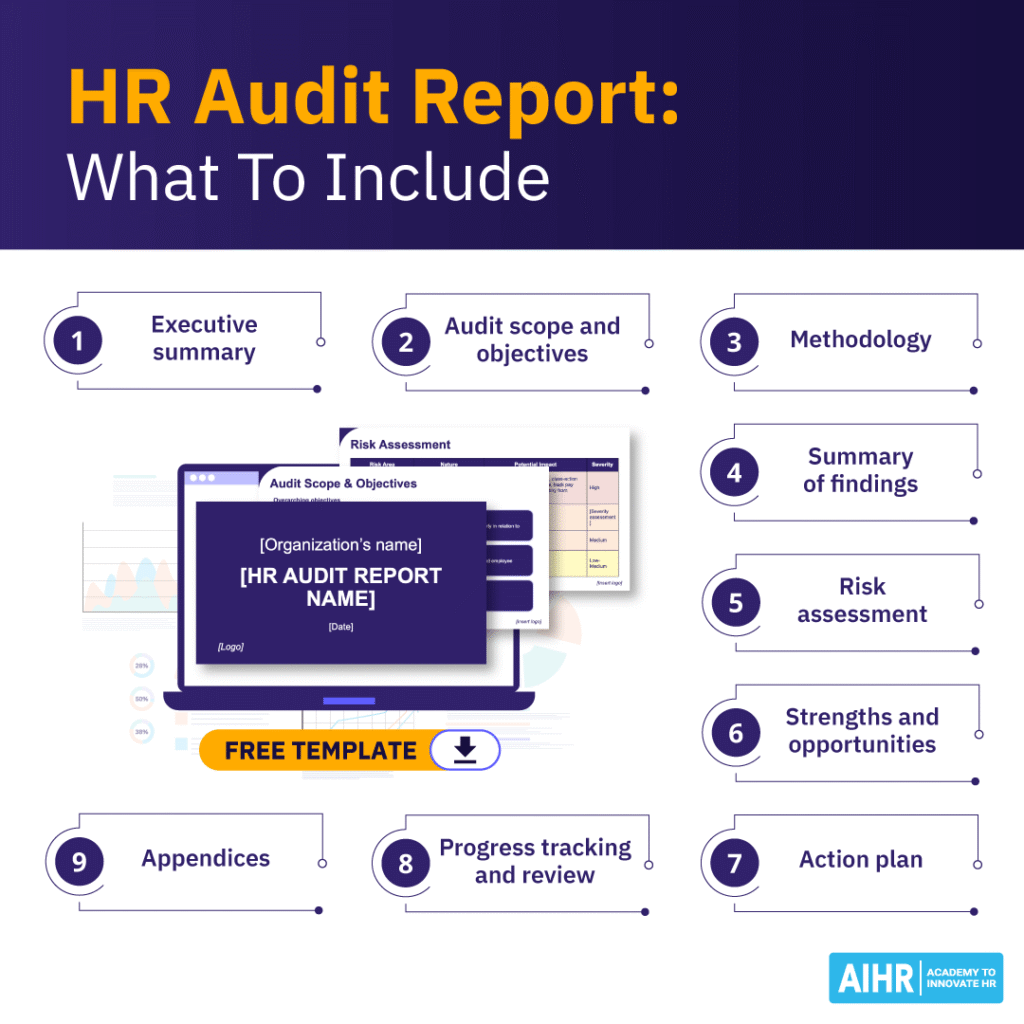
An effective HR audit report doesn’t just report findings; it’s also intended to guide your strategic responses and outcomes. Follow this content structure to build a report that delivers clarity, depth, and impactful insights:

  1. Executive summary: A concise overview of your HR audit’s purpose, the key findings, any major risks identified, and your most critical recommendations. This section should be easily digestible for busy executives, so focus on providing a high-level snapshot of all the sections of your report.
  2. Audit scope and objectives: Clearly outline the purpose of your audit and what it comprises. Include the specific HR policies, processes, and departments that you reviewed (e.g., recruitment, compensation, compliance), the time period covered by the audit, and your overarching objectives (e.g., risk identification, process improvement, compliance verification, or efficiency enhancement).
  3. Methodology: Describe your approach and steps taken to conduct the audit. This involves explaining the process of data collection (e.g., document review, data analysis, employee surveys, interviews with managers and staff), the tools used, and how you analyzed the data to arrive at your conclusions. Providing transparency around your methodology builds credibility.
  4. Summary of findings: Presenting your detailed observations and discoveries is the core of an HR audit report. Structure your findings logically, by HR function or audit area, for example, Recruitment and Onboarding, Compensation and Benefits, HR Compliance, Employee Relations, and Performance Management. Each of your findings should be supported by evidence and data that clearly reflect the current state.
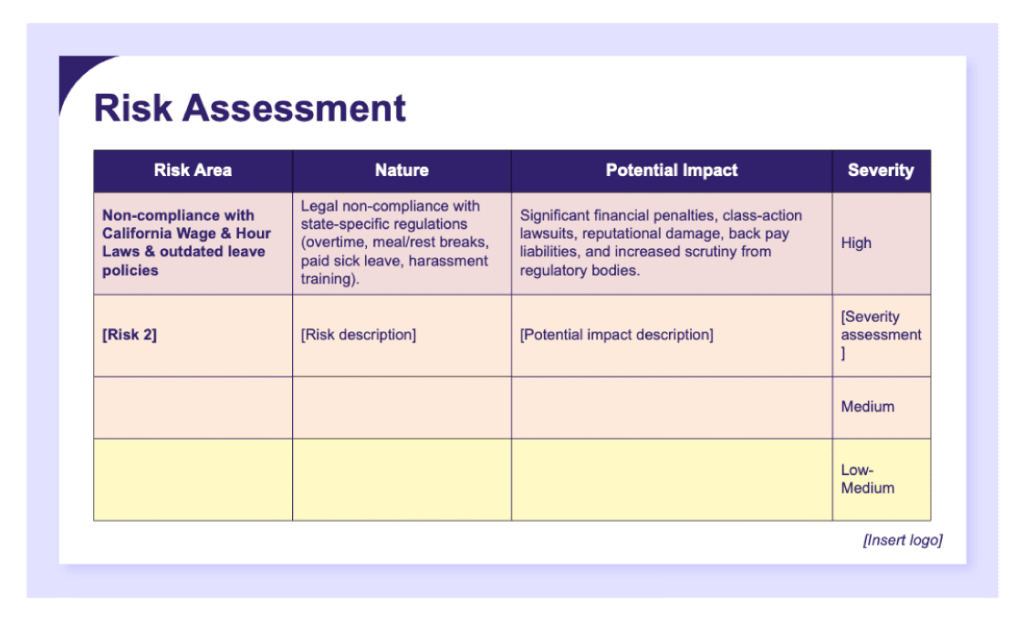
  5. Risk assessment: Assess the associated risks with your findings. Describe the nature of each risk, its potential impact on your organization (e.g., financial, legal, reputational, operational), and its severity (e.g., high, medium, low). This section will help you to prioritize which issues need immediate attention.
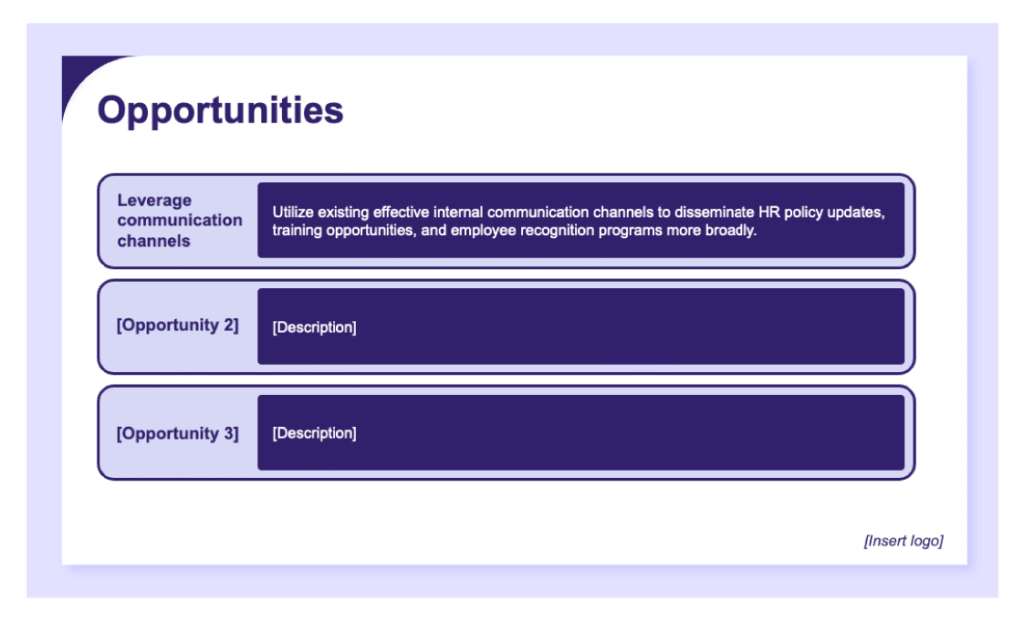
  6. Strengths and opportunities: Highlight the areas where your HR functions are performing exceptionally well by showing their value and effectiveness. It’s necessary to acknowledge strengths and identify opportunities to ensure they’re maintained, grown, and supported by action plans to maximise their positive impact.
  7. Action plan: This section is the crux of the report, as findings without action waste time and opportunity. Your plan should outline specific initiatives to enhance your HR function and achieve better outcomes. Each action point must briefly outline responsibilities, resources, realistic timelines, and the KPIs for success.
  8. Progress tracking and review: Identify how and who will monitor progress on your action plan and appoint a project manager. Set a future follow-up HR audit date to assess the impact of the changes made as a result of recommendations in this report.
  9. Appendices (optional): This section is intended for supporting documentation, such as data tables, survey results, or interview transcripts. Moving supplementary information to an Appendix helps keep your main report concise and focused on core findings and recommendations.
HR audit report format

The way you communicate your findings is just as important as the findings themselves, so use these tips to enhance readability and impact:

  • Choose the right medium:
    • Slides: PowerPoint, Google Slides, Keynote, or other presentation tools are ideal for live meetings, enabling a structured narrative and high-level overview with interactive discussion. Download a free, customizable HR audit report PowerPoint template below.
    • PDF or Word documents: Best for detailed reports, allowing for thorough review, documentation, and comprehensive explanations for broader distribution.
    • Accompanying video: A brief video summary can be highly effective for quickly conveying main points and adding a personal touch. Videos don’t need to be high-budget – simple screen recordings with a voice-over created in tools like Loom can do the trick.
  • Highlight key facts and findings: Use bold text, call-out boxes, or dedicated summary sections to draw immediate attention to important information. This ensures that your audience, particularly your busy senior stakeholders, can quickly grasp high-impact risks or key recommendations.
  • Use visuals strategically: Consider simple visuals, such as traffic light indicators, dashboards, color-coding, or tables, to display status at a glance. And avoid overloading your report with complex graphics that distract from the core message and require extensive explanation.
  • Maintain professionalism: Keep an eye on brand identity, professional fonts, and a clean, uncluttered layout so that nothing distracts from your message. A polished report reflects positively on HR’s attention to detail, making your findings more persuasive.

8 best practices for creating an HR audit report

Follow these pointers to make sure your findings and recommendations deliver impact: 

  1. Write your report with your audience in mind: When communicating with different audiences, such as executives (executive committee or C-suite), HR colleagues, or other stakeholders, it’s important to tailor your language and level of detail to their needs.
    Senior executives are often inundated with presentations and appreciate high-level summaries that highlight key risks, opportunities, and strategic implications, drilling down on business impact and ROI. So, focus on conciseness, actionable insights, and clear visuals to make your report stand out and resonate. On the other hand, your HR colleagues may need more detailed information on processes.
  2. Keep it clear and structured: Use a consistent report format with clear headings, subheadings, numbering, bullet points, and ample white space for breathing room. This will make your report easy to scan and digest, so your message isn’t lost in dense text.
  3. Highlight what matters most: Position high-risk or high-impact findings early in the report, and always include these factors in your Executive Summary. This ensures that the most critical issues receive immediate attention and understanding.
  4. Support findings with evidence: Your conclusions and recommendations should always be backed by relevant data, documentation, policy references, or specific examples. This will increase the credibility of your report and make it easier to shore up support for your findings.
  5. Balance transparency and sensitivity: Be honest and objective about gaps and areas for improvement, but be careful in avoiding language that blames individuals or teams. Use neutral phrasing and focus on solutions to systemic issues instead. The goal should always be to improve, not to criticize.
  6. Maintain confidentiality and accuracy: As an HR leader, you know how important it is to be cautious when sharing sensitive employee and organizational information, especially if the report is to be widely distributed. Double-check all your facts, figures, quotes, and policy references for accuracy before finalizing the report, and anonymize data where possible.
  7. Focus on solutions, not just problems: While identifying issues is key, balance the focus in your report to also include actionable solutions and the positive impact these solutions will have. Frame your findings as opportunities for growth and improvement.
  8. Include a follow-up mechanism: No HR audit report is complete without a clear plan for reviewing progress on your action items. This should involve regular check-ins, follow-up audits, and a designated project manager to ensure accountability.

HR tip: Common mistakes to avoid in reporting

Sidestep these six pitfalls to make sure your HR audit report lands with impact:

  • Overwhelming with data: Don’t just dump raw data; interpret it and highlight the most relevant insights.
  • Overestimating shared understanding: Remember, your audience may not possess the same deep level of HR expertise as you, or familiarity with HR issues, so just don’t assume they understand acronyms, internal processes, or the nuances of HR regulations. 
  • Using jargon: Translate technical HR terms into plain business language for non-HR audiences.
  • Lack of business context: Always connect your HR findings to their broader impact on organizational goals, productivity, or financial health.
  • No clear call to action: Make sure your recommendations are specific, measurable, achievable, relevant and time-bound.
  • Blaming, not solving: Focus on identifying and addressing the causes of systemic issues and solutions rather than assigning individual blame.

HR audit report example

The following example demonstrates what a comprehensive HR audit report might look like in practice. It showcases how findings, risks, and recommendations are typically presented and can be used as a reference for structuring your own HR audit documentation.

HR Audit Report: Golden State Furnishings Inc.

Report date: July 28, 2025
Prepared for: Executive Leadership Team, Golden State Furnishings Inc.
Prepared by: HR Director

1. Executive summary

This HR Audit Report summarizes the findings of a comprehensive review of Human Resources policies, procedures, and systems at Golden State Furnishings Inc., a California-based furniture manufacturing company with approximately 250 employees. The audit aimed to identify areas of strength, compliance gaps, and opportunities for process improvement and efficiency enhancement.

1.1 Key findings
  1. Compliance risk: Significant non-compliance with recent California labor laws, particularly concerning wage & hour regulations and leave policies, posing high legal and financial risk.
  2. Onboarding Inefficiency: Inconsistent and largely manual onboarding process contributing to a high 90-day new hire drop-off rate (35%).
  3. Manual processes: Over-reliance on manual processes for payroll and performance management, leading to inefficiencies and data inconsistencies.
  4. Employee engagement: Strong employee satisfaction with direct supervisors, indicating effective frontline leadership.
1.2 Critical recommendations
  1. Immediate compliance review: Engage labor counsel to update all HR policies and the employee handbook to ensure full California labor law compliance.
  2. Onboarding program revamp: Implement a structured, comprehensive onboarding program to improve new hire retention.
  3. HRIS Implementation: Invest in a modern HR Information System (HRIS) to automate payroll, timekeeping, and performance management.

This report serves as a critical benchmark for future HR strategic initiatives, highlighting actionable insights to enhance operational efficiency, ensure compliance, and foster a more engaged workforce.

2. Audit Scope and Objectives

2.1 Purpose

The purpose of this HR audit was to conduct a systematic review of Golden State Furnishings Inc.’s HR policies, procedures, documentation, and systems to assess their effectiveness, compliance, and alignment with organizational goals.

2.2 Scope

The audit covered the following key HR functions and areas:

  1. Recruitment and onboarding
  2. Compensation and benefits
  3. HR Compliance (with a specific focus on California state and federal labor laws)
  4. Employee relations
  5. Performance management
2.3 Time period covered
  1. The audit itself was conducted over a three-month period (April 1, 2025, to June 30, 2025). 
  2. The data, policies, and practices reviewed covered the preceding twelve months, from April 1, 2024, to March 31, 2025.
2.4 Overarching objectives
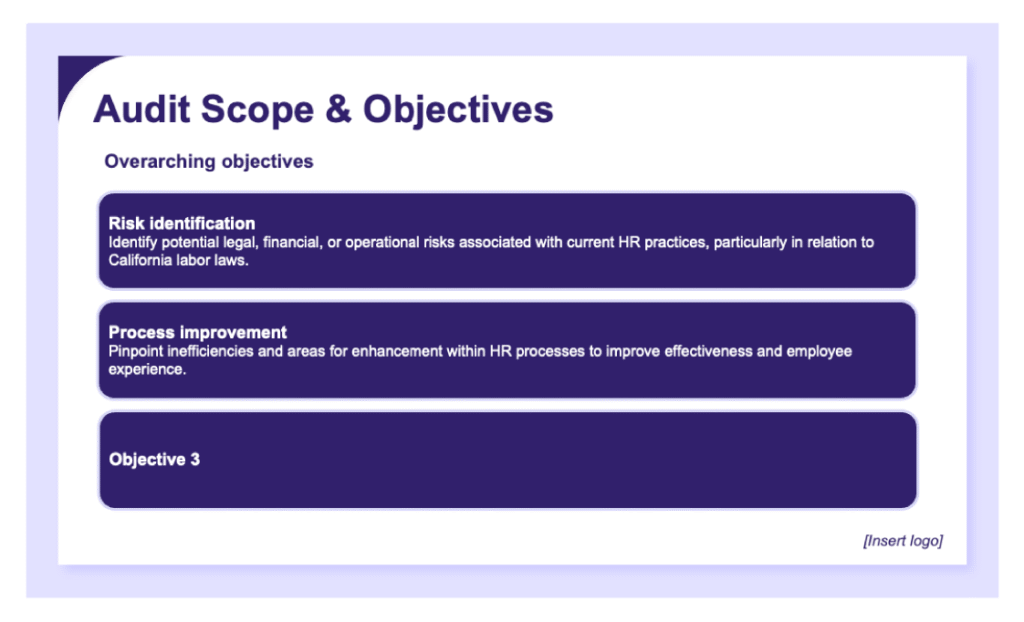
  1. Risk identification: Identify potential legal, financial, or operational risks associated with current HR practices, particularly in relation to California labor laws.
  2. Process improvement: Pinpoint inefficiencies and areas for enhancement within HR processes to improve effectiveness and employee experience.
  3. Compliance verification: Ensure all HR policies and procedures align with current federal and California state employment laws and regulations.
  4. Efficiency enhancement: Evaluate opportunities to streamline HR operations through automation or revised workflows.

3. Methodology

The audit adopted a multi-faceted approach to ensure comprehensive data collection and analysis:

3.1 Data collection
  1. Document review: Thorough examination of the employee handbook, HR policies, job descriptions, offer letters, employment contracts, payroll records, performance review forms, training materials, and termination documentation.
  2. Data analysis: Quantitative analysis of HR metrics including turnover rates (overall, 90-day new hire), time-to-hire, compensation data, and performance review completion rates, extracted from the existing HRIS and payroll systems.
  3. Employee surveys: An anonymous online employee engagement survey was conducted across all departments to gather qualitative feedback on HR services, workplace culture, and management effectiveness.
  4. Interviews: Structured interviews were conducted with the HR team (HR Director, HR Generalists), department managers (Production, Sales, Administration), and a representative sample of employees from various departments and seniority levels.
3.2 Tools used
  1. HRIS data export and reporting tools
  2. SurveyMonkey for employee engagement surveys
  3. Standardized interview questionnaires and checklists for consistency
  4. California Labor Law compliance checklists.
3.3 Data analysis

Data collected from various sources was cross-referenced to identify patterns, discrepancies, and areas requiring attention. Findings were benchmarked against industry best practices for furniture manufacturing and against current California and federal employment laws to determine compliance status and identify opportunities for improvement.

4. Summary of findings

This section details observations and discoveries, categorized by HR function, supported by evidence and data reflecting the current state.

4.1. Recruitment and onboarding

Finding 1: 

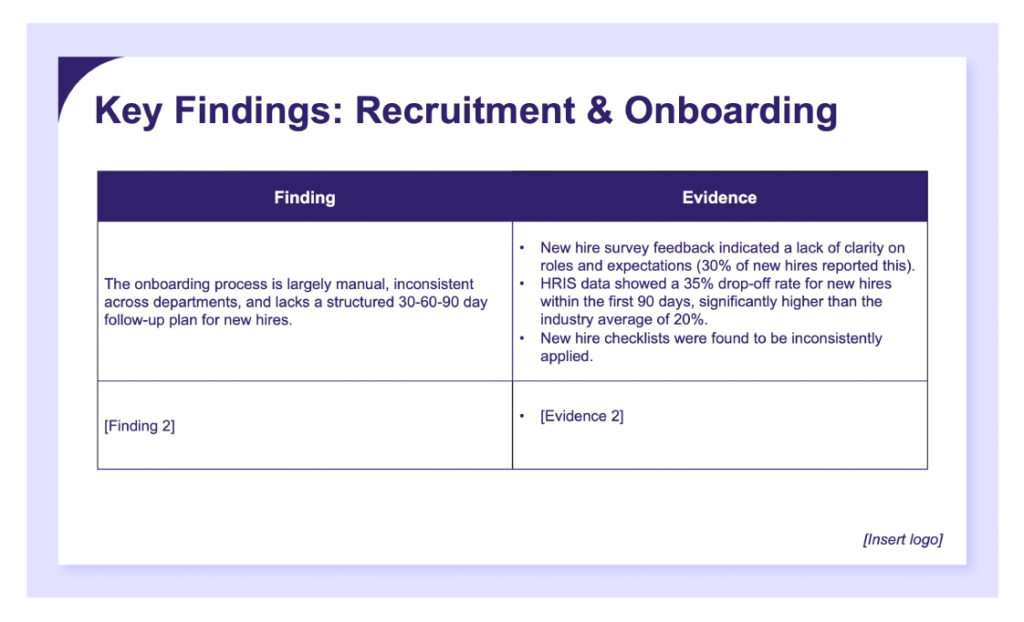
The onboarding process is largely manual, inconsistent across departments, and lacks a structured 30-60-90 day follow-up plan for new hires.

  • Evidence: New hire survey feedback indicated a lack of clarity on roles and expectations (30% of new hires reported this). HRIS data showed a 35% drop-off rate for new hires within the first 90 days, significantly higher than the industry average of 20%. New hire checklists were found to be inconsistently applied.

Finding 2: 

Time-to-hire metrics are longer than industry averages for key manufacturing roles due to a fragmented interview process.

  • Evidence: Average time-to-hire for production roles: 65 days (industry average: 45 days).
4.2. Compensation and benefits

Finding 1: 

Payroll processing is entirely manual, consuming approximately 200 hours per month of HR and Finance staff time.

  • Evidence: Time tracking logs and interviews with HR/Finance staff.

Finding 2: 

Inconsistencies were identified in the calculation of overtime and meal/rest break compliance for non-exempt production employees, particularly regarding the rounding of time punches and proper documentation of waivers.

  • Evidence: Audit of 20 randomly selected payroll records revealed 15% with potential non-compliance issues related to California’s daily overtime and meal/rest break requirements.
4.3. HR Compliance

Finding 1: 

The employee handbook was last comprehensively updated in 2020. Several policies, including paid sick leave (e.g., California’s SB 616), leave of absence, and harassment prevention training requirements, are not fully compliant with recent California labor law changes.

  • Evidence: Legal counsel review of the current handbook and comparison against the updated California Labour Code.

Finding 2: 

Documentation for I-9 forms was inconsistent, with some forms missing or incomplete.

  • Evidence: Review of 10% of active employee I-9 forms showed a 10% error rate.
4.4. Employee relations

Finding 1: 

The grievance and disciplinary processes are perceived as informal and inconsistent by employees and managers, leading to a lack of trust in resolution fairness.

  • Evidence: Employee interviews indicated varying experiences with issue resolution. Managers reported a lack of clear guidelines for disciplinary actions.

Finding 2: 

Managers lack formal training in conflict resolution and difficult conversations.

  • Evidence: Feedback from manager interviews.
4.5. Performance management

Finding 1: 

The annual performance review process is frequently delayed or skipped, with no clear link established between performance outcomes, employee development plans, or compensation adjustments.

  • Evidence: HRIS data showed only a 45% completion rate for annual performance reviews in the past year. Employee surveys indicated a desire for more frequent and constructive feedback.

5. Risk assessment

This section assesses the associated risks with the identified findings, their potential impact, and severity.

Risk Area Nature Potential Impact Severity
Non-compliance with California Wage & Hour Laws & Outdated Leave Policies Legal non-compliance with state-specific regulations (overtime, meal/rest breaks, paid sick leave, harassment training). Significant financial penalties, class-action lawsuits, reputational damage, back pay liabilities, and increased scrutiny from regulatory bodies. High
High New Hire
Drop-off Rate
(35% in 90 days)
Ineffective onboarding leading to early attrition. Increased recruitment costs (estimated at $5,000 per lost employee), loss of institutional knowledge, reduced productivity, negative employer brand, and difficulty attracting future talent. Medium
Manual HR Processes (Payroll, Performance) Inefficient, labor-intensive processes prone to human error. High operational costs, data inaccuracies, delayed reporting, reduced HR team capacity for strategic initiatives, and potential compliance errors. Medium
Inconsistent Employee Relations & Performance Management Lack of standardized processes for grievances and performance feedback. Decreased employee morale, disengagement, potential for unresolved conflicts escalating, reduced individual and organizational productivity, and difficulty in identifying and developing high-potential employees. Low-Medium


6. Strengths and opportunities

Acknowledging existing strengths and identifying opportunities is crucial for leveraging current successes and guiding future improvements.

6.1. Strengths
  1. Effective internal communication: Golden State Furnishings Inc. maintains strong internal communication channels for company-wide announcements and operational updates, ensuring employees are generally well-informed about business developments.
  2. Strong supervisor-employee relationships: Employee survey results indicate high satisfaction with direct supervisors, highlighting effective frontline leadership and positive team dynamics in many areas.
  3. Robust safety training: The company has a well-established and regularly updated safety training program for its manufacturing operations, demonstrating a commitment to employee well-being and compliance with OSHA standards.
6.2. Opportunities
  1. Leverage communication channels: Utilize existing effective internal communication channels to disseminate HR policy updates, training opportunities, and employee recognition programs more broadly.
  2. Develop managerial training: Build on the strength of positive supervisor-employee relationships by developing targeted training programs for managers in areas such as conflict resolution, performance feedback, and coaching, to standardize best practices.
  3. Automate HR processes: Significant opportunity to automate manual HR processes (e.g., payroll, timekeeping, performance reviews) through an integrated HRIS, freeing up HR staff for more strategic initiatives and reducing errors.
  4. Proactive compliance monitoring: Implement a system for continuous monitoring of California labor law changes to ensure ongoing policy compliance and reduce future risk.

7. Action plan

This section outlines specific initiatives to enhance the HR function, specifying responsibilities, resources, realistic timelines, and KPIs for success.

Action Item 1: HR Compliance Review & Update
Initiative Responsibility Resources Timeline KPIs for Success
Engage external labor counsel to conduct a comprehensive review of all HR policies, procedures, and the employee handbook. Update all non-compliant policies to align with current California and federal labor laws (e.g., SB 616, wage & hour regulations, harassment prevention training). HR Director (Lead), Legal Counsel, HR Generalists Dedicated legal budget (estimated $15,000), HR team time for policy drafting and review. Q3 2025 (Completion by September 30, 2025) 100% of identified non-compliant policies updated and approved by legal counsel. New employee handbook published and distributed to all employees. Zero compliance-related penalties or lawsuits in the next 12 months.


Action Item 2: Revamp Onboarding Program
Initiative Responsibility Resources Timeline KPIs for Success
Design and implement a structured, comprehensive 90-day onboarding program that includes: pre-boarding communication, a standardized first-day experience, role-specific training pathways, a mentorship program, and scheduled check-ins (30, 60, 90 days) with HR and managers. HR Manager (Lead), Department Heads, HR Generalists HR team time for program development, training materials budget, potential HRIS module for onboarding tracking. Q4 2025 (Pilot program launch by December 31, 2025) 90-day new hire retention rate increases to 75% by Q2 2026. New hire satisfaction scores (onboarding experience) improve by 20% in post-onboarding surveys.


Action Item 3: HRIS Implementation for Payroll & Performance
Initiative Responsibility Resources Timeline KPIs for Success
Research, select, and implement a new, integrated HR Information System (HRIS) to automate payroll processing, timekeeping, and performance management workflows. This will replace current manual systems and provide better data analytics. HR Director (Lead), Finance Director, IT Manager, external HRIS consultant (if needed). Allocated budget for HRIS software license (estimated $30,000 – $50,000 annually) and implementation costs, dedicated project team time. Q1 2026 (Vendor selection by January 31, 2026; Phased implementation through Q3 2026) Payroll processing time reduced by 50% within 3 months of system launch. Performance review completion rate increases to 90% within 6 months of system launch. Reduction in payroll-related errors by 75%.


8. Progress tracking and review

  1. Progress on these three action items will be reviewed bi-weekly by the HR leadership team and reported quarterly to the Executive Leadership Team
  2. The HR Director, as designated project manager, will oversee the implementation of these action items and track KPIs
  3. A follow-up HR audit will be scheduled for July 2026 to assess the impact of these changes.

9. Appendices

This section contains the following supporting documentation:

  1. Detailed employee survey results and verbatim comments
  2. Raw HRIS data tables (e.g., turnover rates by department, time-to-hire by role)
  3. Interview transcripts (anonymized)
  4. Specific California Labor Code references for compliance issues
  5. Cost-benefit analysis for HRIS implementation.
SEE MORE

HR audit report template

Download and customize our pre-built HR audit report template to save time in building an impactful and professional PowerPoint presentation.
A final word

An HR audit report should go beyond simply reporting data and findings. Its true value is in highlighting strengths, identifying weaknesses, pinpointing gaps, and showcasing opportunities within your HR processes, data, and systems.

By following the structured approach outlined in this guide to document and communicate these insights, you can transform potential liabilities into catalysts for growth, enhance compliance, and solidify HR’s role as a partner and drive value across your organization.

The post How To Prepare an Impactful HR Audit Report [Free Template] appeared first on AIHR.


Get the Latest HR Headlines

* indicates required

HR NEWS MARKETPLACE


»See how your employer brand stacks up against the competition with CLEO Ai


»Free CRM Audit from Dalia


»Cliquify + Top Employers Institute 2025 Employer Brand Priorities Report


»Diversity and Inclusion Job Board


»HR Technology Wire


»Job Board Directory


»Optimize Your Recruitment Marketing with Jobsync


»Recruiting Newsletters


»HR Tech News


»Jobs with Relocation Assistance


»Recruiter Ebooks